How to Read an Olive Oil Polyphenol Lab Report
Read a polyphenol report with confidence: understand the units, compare methods, and match the dates and lot to your bottle.

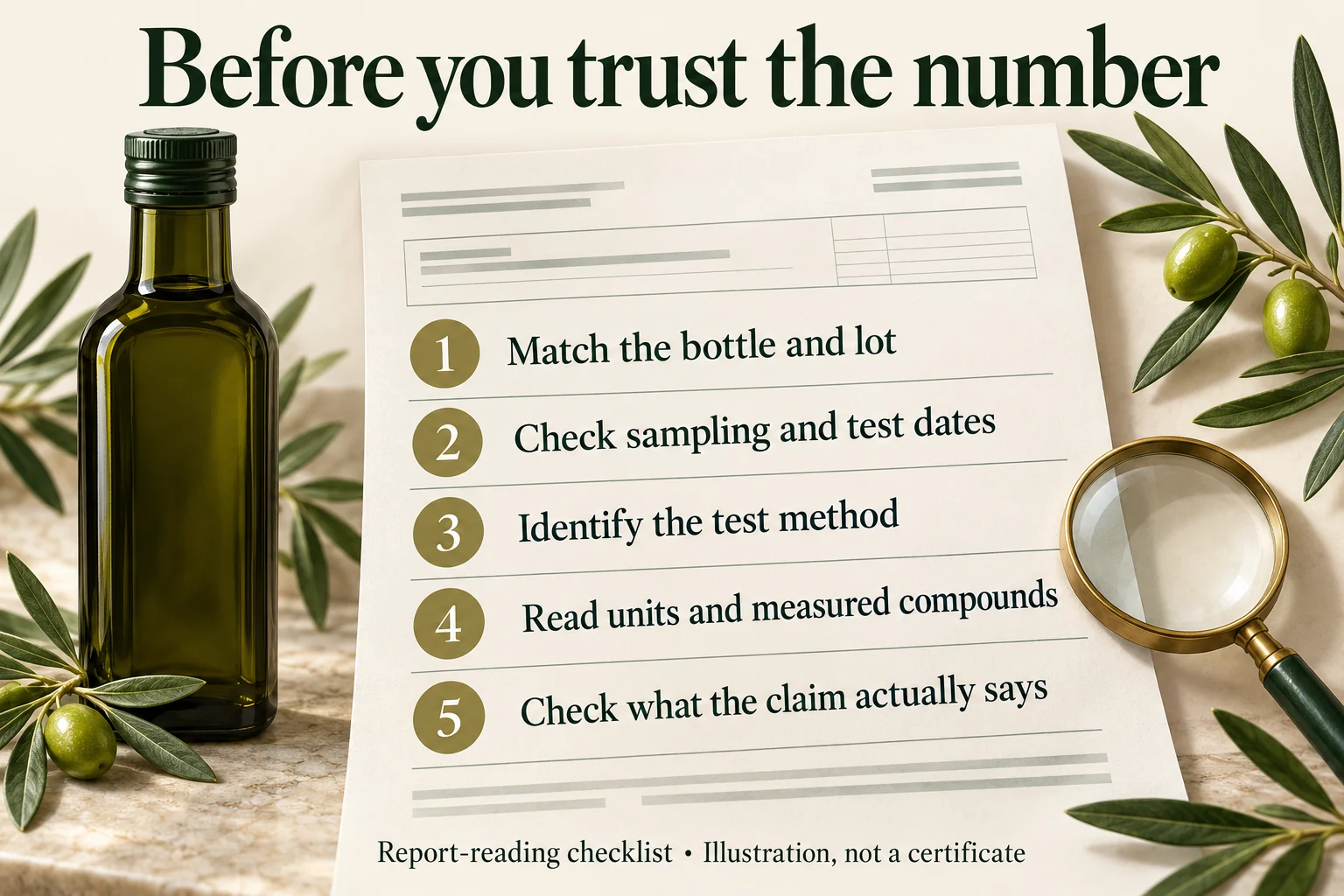
To read an olive oil polyphenol lab report, start with five details: the sample’s identity, test date, method, reporting units, and measured compounds. Those details tell you what a result such as 600 mg/kg actually describes.
I’ll walk you through each part of the report, explain why HPLC and NMR results can differ, and show you how to match the certificate to a bottle’s harvest and lot.
By the end, you’ll know which results you can compare and which questions to ask when a certificate leaves something out.
What does mg/kg mean on an olive oil label?
Mg/kg means milligrams per kilogram. It expresses a concentration: how much of the measured material is present in a kilogram of oil. A kilogram is 1,000 grams.
An illustrative result of 500 mg/kg therefore means 0.5 milligrams per gram of oil. It does not mean that each spoon contains 500 milligrams, and it is not a score out of 1,000.
Sometimes you will see parts per million, or ppm. When it is explicitly a mass-to-mass concentration, 1 ppm equals 1 mg/kg. A result in mg/L uses volume instead, so you cannot substitute it directly without accounting for density.
Also read the words around the units. “Total phenols as tyrosol equivalents” is different from a direct sum of the masses of named compounds. The reference standard is part of the result, not a decorative footnote.
How to calculate the amount in a serving
The calculation is straightforward once the result and serving use compatible units:
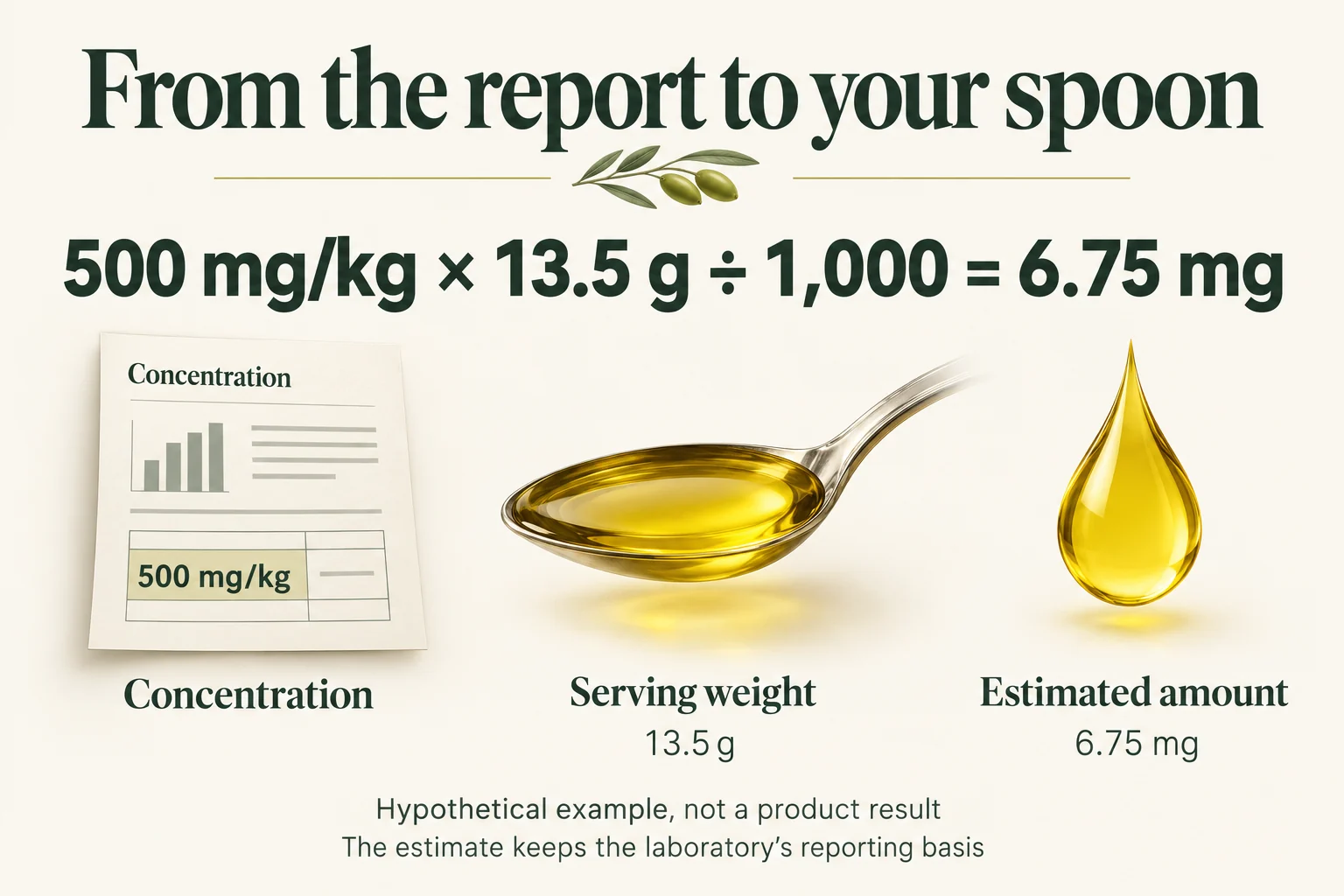
Reported mg/kg × serving weight in grams ÷ 1,000 = estimated milligrams in that serving.
For a hypothetical oil reported at 500 mg/kg:
- 5 grams of oil: 500 × 5 ÷ 1,000 = 2.5 mg.
- 13.5 grams of oil: 500 × 13.5 ÷ 1,000 = 6.75 mg.
- 20 grams of oil: 500 × 20 ÷ 1,000 = 10 mg.
These are examples, not measurements of a product or therapeutic targets. The result retains the laboratory’s definition. If the certificate reports tyrosol equivalents, your calculation is an amount on that equivalent basis; it does not suddenly become pure hydroxytyrosol.
Weighing oil gives you a clearer calculation than estimating a pour. It still cannot tell you exactly how much of each compound your body will absorb or whether that serving will produce a particular health outcome.
Why HPLC, NMR, and color tests can disagree
Different methods can be useful for different questions. I would not dismiss a result simply because it uses a method other than the one on a competing bottle. I would ask what it measured and how the total was calculated.
HPLC separates compounds before measuring them
High-performance liquid chromatography, or HPLC, separates components of a prepared sample. The laboratory then detects and quantifies them according to its protocol.
The International Olive Council publishes an HPLC method for olive oil biophenols. Its existence does not mean every report labeled “HPLC” uses the same procedure. Detector, extraction, calibration, hydrolysis, and reporting choices can affect what is included.
Ask for the method reference and the basis of the total. A certificate that identifies both is easier to interpret than an advertisement that gives only three initials.
Quantitative NMR measures selected molecular signals
Nuclear magnetic resonance, or NMR, uses signals associated with molecular structure. Quantitative NMR methods can measure selected olive oil phenolics, including oleocanthal and oleacein.
Karkoula and colleagues’ 2012 method paper is an example of research focused on those compounds. A total based on selected NMR measurements is not automatically identical to a total produced by another assay.
Avoid universal conversion rules such as “subtract 20% from NMR.” A ratio observed for one oil and protocol is not a conversion factor for every oil. Ask which compounds were quantified and added together.
Folin-Ciocalteu estimates a response to a color reaction
This assay uses a chemical reaction to estimate a total, often expressed relative to a reference compound. It does not separate and identify every individual phenolic molecule.
Research on the Folin-Ciocalteu reagent shows that nonphenolic reducing substances can also react. That helps explain why the result should not be treated as a complete compound-by-compound inventory.
A colorimetric measurement can be useful within a validated, consistent protocol. The mistake is treating all laboratory totals as interchangeable because they end with “mg/kg.”
Can you compare results from two different laboratories?
Sometimes, but I would want more than matching method names. A fair comparison asks whether the laboratories measured the same analytes, used compatible preparation and calibration, reported on the same basis, and tested comparable samples at comparable ages.
Even two reported values for the same named compound can have different uncertainty. A small numerical gap may not support a meaningful ranking.
Consider this hypothetical comparison:
- Oil A: 700 mg/kg, total biophenols by a specified HPLC procedure, tested near harvest.
- Oil B: 900 mg/kg, a selected-compound NMR total, tested several months after harvest.
You can accurately describe each report. You cannot conclude from those two numbers alone that Oil B provides 29% more of the same compounds, or 29% more health benefit.
If a seller wants to make a precise head-to-head claim, a useful next step would be testing representative current samples using the same suitable protocol. The burden should not fall on you to invent a conversion.
What does the EU’s 5 mg claim actually require?
The EU regulation sets a minimum of 5 mg of hydroxytyrosol and its specified derivatives per 20 grams of olive oil. It also requires daily-intake information. Dividing 5 mg by 0.02 kg gives 250 mg/kg of the qualifying group.
That calculation is not a universal definition of “high polyphenol,” and a generic total above 250 mg/kg does not automatically verify eligibility. Analytical research addressing the claim explains why the measurement and calculation basis require care.
I’d ask the laboratory or producer to explain the claim-specific result rather than reverse-engineering it from an unrelated total.
Read three dates, not just one
A useful certificate or supporting record lets you distinguish:
- Harvest date: when the olives were harvested.
- Sampling date: when oil was taken for testing.
- Analysis date: when the laboratory measured that sample.
The report’s issue date may be different again. A recently issued document does not necessarily mean that the oil was recently harvested or sampled.
Match the report’s lot identifier to the bottle being sold. A superb result from a previous harvest is evidence about that sample. It does not establish the composition of every later bottle bearing the brand’s name.
A practical email to the seller is: “Does this report apply to the lot you will ship, and when was that lot sampled?” That is often more useful than asking whether the brand is “the highest.”
How much does the number change during storage?
Phenolic compounds change during storage, and their behavior is not uniform. A study following oils with different initial phenolic profiles found that the starting composition affected subsequent changes.
That is why I would not apply a fixed monthly loss to every bottle or promise that a particular starting number will remain above a threshold for years. Temperature, light, oxygen exposure, packaging, and composition all complicate that prediction.
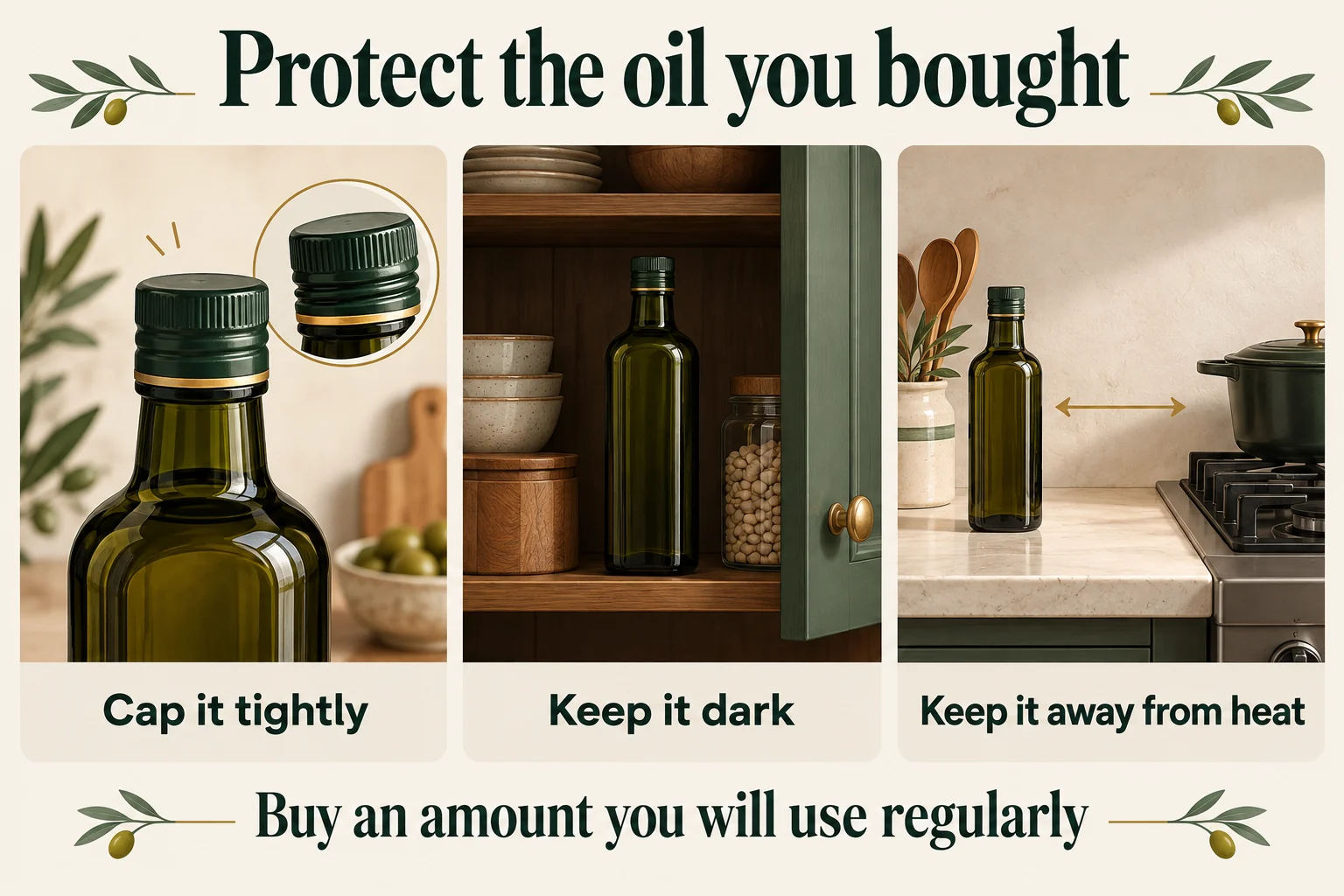
Buy an amount you will use, keep it capped in a cool, dark place, and avoid storing it beside the stove. If the exact current concentration is essential to a claim, a new measurement is more dependable than a formula based only on elapsed months.
Can you test polyphenols at home?
You can assess whether you enjoy the oil, but taste does not produce a reliable mg/kg result. Bitterness and a peppery throat sensation can be clues about phenolic composition. They are not substitutes for a suitable assay.
Color, refrigeration behavior, and the number of times you cough also cannot certify the concentration. A home observation should not be used to declare a bottle adulterated or chemically superior.
You generally do not need to commission your own laboratory work to choose a cooking oil. If a premium price depends on a specific number, request the producer’s documentation first.
What a lab report can and cannot verify
A lab report describes the sample tested, the method used, and the result at that time. It does not establish that every bottle from the same brand has the same composition, or that a higher concentration delivers a greater health benefit.
I use the report to check whether the evidence supports a specific claim about a specific lot. If the sample, units, or method are unclear, ask the laboratory or producer to explain them before drawing a conclusion.
For the compounds behind the measurements, read my guide to olive oil polyphenols. For brand comparisons and buying options, use the separate high-polyphenol olive oil comparison.
My five-point lab-report checklist
- Identity: brand, oil, harvest, and lot match what you are buying.
- Timing: sampling and testing dates are clear.
- Method: the procedure and reporting basis are named.
- Result: units, included compounds, and relevant uncertainty are understandable.
- Claim: the marketing statement is supported by that result, without turning composition into a disease-treatment promise.
If one detail is missing, ask for it. You do not need a perfect-looking certificate; you need enough information to understand what the number can reasonably tell you.
Frequently asked questions
Is 1,000 mg/kg always better than 500 mg/kg?
No. First establish whether the measurements are comparable and apply to the current lots. Even then, twice the reported concentration does not demonstrate twice the clinical benefit. Taste, storage, serving size, price, and the broader diet also matter. I would prefer an interpretable report to an impressive number with no supporting details.
Does “lab tested” mean independently verified?
Not necessarily. It tells you that some testing is claimed, but not who selected the sample, which laboratory tested it, or whether it matches the bottle on sale. Ask for the actual report and lot information. Laboratory accreditation can support competence within its scope, but it does not certify every marketing statement.
Can a high-polyphenol oil fail extra virgin standards?
Yes. Phenolic concentration is only one compositional measurement. Extra virgin classification also depends on other chemical and sensory requirements. A high polyphenol total cannot compensate for a defect or establish the grade by itself. Read a phenolic certificate as evidence about the compounds tested, rather than a complete quality verdict.
Should I ignore a report from last year?
Not automatically. Check the harvest, lot, sampling date, and how the oil has been stored. An older report may still describe the original batch correctly, but it does not establish its exact current composition. It becomes misleading when it is presented as a current measurement or used for a different harvest.
About the Author
Based in San Diego, Dr. Erez, D.O. is a 5-star rated integrative medicine practitioner with over 5 years of experience running his own private practice and treating hundreds of patients. He is an Institute for Functional Medicine Certified Practitioner (IFMCP) and is board-certified by the American Board of Family Medicine.
A frequent medical source, he has contributed to publications including Everyday Health, Epoch Health, California Mobility, and Woman's World. Dr. Erez is most passionate about helping individuals identify the root causes of chronic disease and leverage evidence-based interventions to reach their version of optimal health.