From Prediabetic to Half Marathons
His goal was simple: a healthy BMI and a body that let him hike and travel again. Less than a year later, he'd lost 91 pounds, reversed his prediabetes, and was training for half marathons.
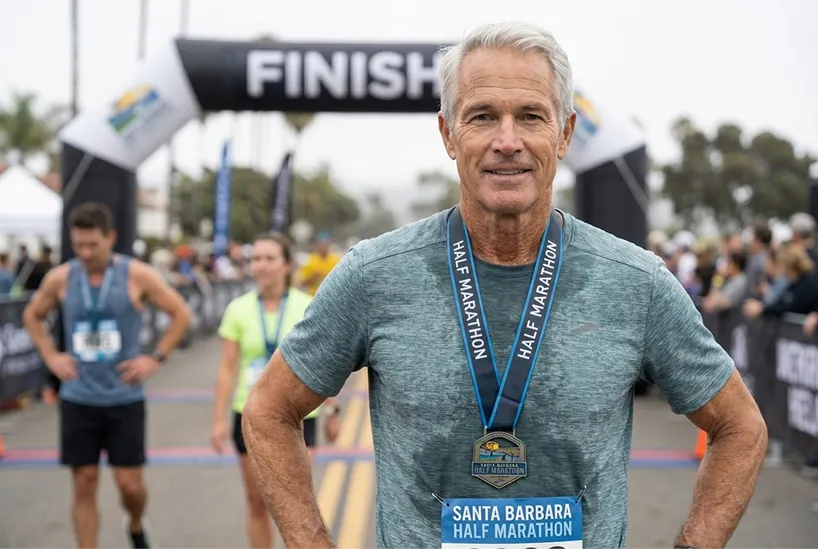
This is a real patient story. The name and identifying details have been changed to protect privacy, but the health journey, lab results, and outcomes are exactly as they happened.
The images are AI generated to protect their identity.

Where he started
When Michael first sat down with me, he didn't lead with lab numbers or medical history. He told me he couldn't hike anymore.
He used to love it. But within the last couple of years, the added weight had made it miserable.
"My joints seem okay," he said, "but I tire out more easily." Road trips, which he and his partner used to enjoy without a second thought, had turned into a different kind of frustrating. He had to stop every 30 minutes to use the bathroom, then get back in the car, only to need to stop again shortly after.
Sleep was another problem.
He had trouble falling asleep and staying asleep, waking up during the night and lying there unable to get back down. He snored, and it was getting worse as the weight crept up.
He was in his late 50s, recently back at work in customer service after a few years off, and carrying 236 pounds on a 5'10" frame. He wasn't coming in with a complicated medical request. He just wanted his life back.
"I think it's really getting over the hurdle to add that routine. If I would get up every morning and put aside 20 minutes and start with a walk around the block, I know that's what I need."
– Michael
Michael's struggle with consistency stuck with me, because I hear some version of it from almost every patient who walks through my door. They know what to do. They just can't close the gap between knowing and doing, and that gap gets wider the longer you sit in it.
What our testing revealed
When I dug into Michael's labs, the picture behind his symptoms started to come together. What looked like a collection of separate problems on the surface was actually a connected web of metabolic issues, each one feeding into the next.
Baseline Findings
- A1c at 6.0, right at the doorstep of diabetes
- Elevated insulin levels indicating insulin resistance
- Cholesterol requiring the maximum statin dose, with a family history adding to the risk
- Vitamin D quite low
- B12 on the lower end
- Erectile dysfunction
- Snoring and nighttime waking consistent with sleep apnea
Michael wasn't just "overweight and tired." Every one of the things he'd described in his own words, the hiking, the road trips, the sleep, the fatigue, all traced back to what was happening inside his body.
The insulin resistance alone explained a lot.
It's the kind of thing that quietly drives weight gain, fatigue, sugar cravings, and the feeling that your body is working against you no matter what you do. And sleep apnea, if that was in the picture, would be sabotaging everything from testosterone to blood sugar to the energy he needed to actually get up and exercise in the morning.
The good news was that most of it was reversible. We just had to start pulling the right threads.
The holistic protocol
I didn't try to overhaul Michael's life in one visit. That's a recipe for two good weeks followed by a slow slide back to exactly where you started.
We began with the basics. Three walks a week, Monday, Wednesday, and Friday.
Breakfast without the bagel or toast, swapping in eggs, turkey sausage, and avocado instead. Less bread at lunch and more salads with protein.
A sleep protocol built around magnesium threonate and 5-HTP to help him actually stay asleep through the night, coupled with a referral for a sleep study, because if sleep apnea was in the picture, it would undermine everything else we were trying to do.
Low-dose Tadalafil to address the erectile dysfunction and support prostate health.
And Mounjaro, starting at the lowest dose of 2.5mg, to help with blood sugar control and reduce the cravings that had been pulling him toward bread and sugar for years.
But the piece I want to highlight, because I think it's the piece most practices overlook entirely, is the accountability system.
I asked Michael to text me a photo every time he went out for his walk, Monday, Wednesday, and Friday to show proof he got out the door.

I do this with most of my patients, because I've learned that the number one predictor of whether someone follows through isn't motivation or willpower. It's whether another human being is paying attention. When you know your doctor is going to see that you didn't walk this morning, you're more likely to go for the walk.
It's that powerful.
A few weeks later, when Michael got an Apple Watch, I connected with him through Apple Fitness so we could each see the other's workouts. When he finished a run, I'd see it. When I finished a workout, he'd see mine.
It created this quiet mutual accountability that kept the momentum going even on days when neither of us felt like it.
The middle of his journey
Significant health transformations aren't easy.
By his second visit, Michael was losing weight and feeling lighter on his feet, but he was struggling with protein intake.

He could hit maybe 60% of where he needed to be, but getting above that felt like a mountain he couldn't climb. We worked through it together, though, adding in nonfat Greek yogurt, cottage cheese, protein shakes, and high-protein bars as practical options he could actually fit into his day.
He hadn't joined a gym yet. He was thinking about it, circling around it, trying to figure out where it fit in his schedule.
He mentioned the Peloton at home that he hadn't touched. He talked about Orange Theory and Planet Fitness but hadn't committed to either one. I told him to pick whichever one was closest and could be reached in under 10 minutes, because convenience beats quality when you're building a new habit.
The bread wasn't totally gone either.
He'd cut way back, but a slice of toast in the morning was still hanging around. We just kept nudging it in the right direction without making it feel like a failure.
This is the part of the process that doesn't make it into most success stories, but it's the part that matters most. Real change is messy. People don't flip a switch and become different overnight.
But Michael was committed.
Throughout the process, he fell in love with running.
It all started with three walks a week. Within months, walking turned into running, and running turned into racing.
The turning point
By his third visit, I almost didn't recognize the person on my screen.
"I've been in the best mood and shape since high school."
– Michael, Visit 3

He'd lost about 60 pounds. He was working out three to four days a week, and he'd even completed four half marathons in a single year.
The Results
Michael's metabolic dysfunction, completely reversed
Every marker improved. Most reached levels better than patients who've never had a problem.
The Full Picture
Every intervention that played a role
Michael's transformation wasn't one thing. It was a layered, holistic approach where each change built on the one before it.

Photo Accountability
A daily check-in system where patients send photos of their workouts, meals, or movement directly to their doctor. The simple act of knowing someone is watching closes the gap between knowing what to do and actually doing it.

Health & Fitness Wearables
Smartwatches, fitness trackers, and continuous glucose monitors that turn day-to-day habits into shared, visible data. Activity, sleep, heart rate, and blood sugar all become part of the conversation between patient and doctor.

Walking Program
A progressive walking program tailored to the patient's starting fitness level, building toward more demanding cardiovascular goals over time.

Diet Restructuring
A protein-forward, lower-carb eating pattern focused on stable blood sugar, sustained energy, and reducing cravings.

GLP-1 Therapy
A class of medications that improve blood sugar control, reduce cravings, and support sustainable weight loss. Used as a bridge while patients build the habits that will carry the results long-term.

Sleep Protocol
A personalized approach to improving sleep quality and duration, including supplementation, sleep hygiene adjustments, and screening for underlying issues like sleep apnea when warranted.

Strength Training
Resistance training to preserve muscle mass during weight loss and support long-term metabolic health.

Hormone Replacement Therapy
Bioidentical hormone optimization for patients with clinically low or imbalanced levels. Supports energy, recovery, mood, and overall vitality at any age.

Targeted Supplementation
Personalized supplementation guided by lab results and individual goals. Addresses specific deficiencies and supports the body systems that need extra reinforcement.
Why It Worked
Three principles behind the transformation
01
The Accountability System
Michael already knew what to eat and that he should be walking. What he needed was someone who would notice if he didn't show up. That changes the equation from willpower, which runs out, to partnership, which compounds.
02
Medication as a Bridge, Not a Crutch
Mounjaro bought Michael time to build the habits that would sustain the results on their own. By visit three, he was already planning to taper off. The goal is always the same: get you to a place where your body doesn't need the tool anymore.
03
Stacking Small Changes
We started with three walks and breakfast without bread. That was it. Each new layer, protein, gym, weight training, testosterone, was only introduced after the previous one felt like second nature.
The new Michael
By the fourth visit, Michael weighed 145 pounds. Down 91 pounds from where he started. He'd fully adopted weight training and was asking about testosterone replacement to support his increasingly athletic lifestyle.
His main complaint at that point wasn't pain or fatigue or blood sugar. It was that he wanted more energy for his workouts.
Think about that for a second. This is a man who, less than a year earlier, told me he couldn't hike anymore because he tired out too easily. Now his biggest concern was optimizing his race performance.

"I feel like I'm 18 years old again sometimes."
Michael, Visit 4
Michael had gone from dreading a walk around the block to running seven miles on days he'd only planned for three. From avoiding hikes to completing the Golden Bear Medal series, four qualifying half marathons across California.
From a body that was slowly sliding toward diabetes to lab numbers that most of my healthiest patients would envy.

He didn't come in planning to run half marathons. He came in wanting a body that would let him hike and travel again.
Michael's planning a half marathon in Paris now.
I still get the exercise photos.