Should You Take an Olive Oil Shot Every Day?
A practical guide to portions, timing, and choosing an oil, with the evidence separated from the shot ritual.

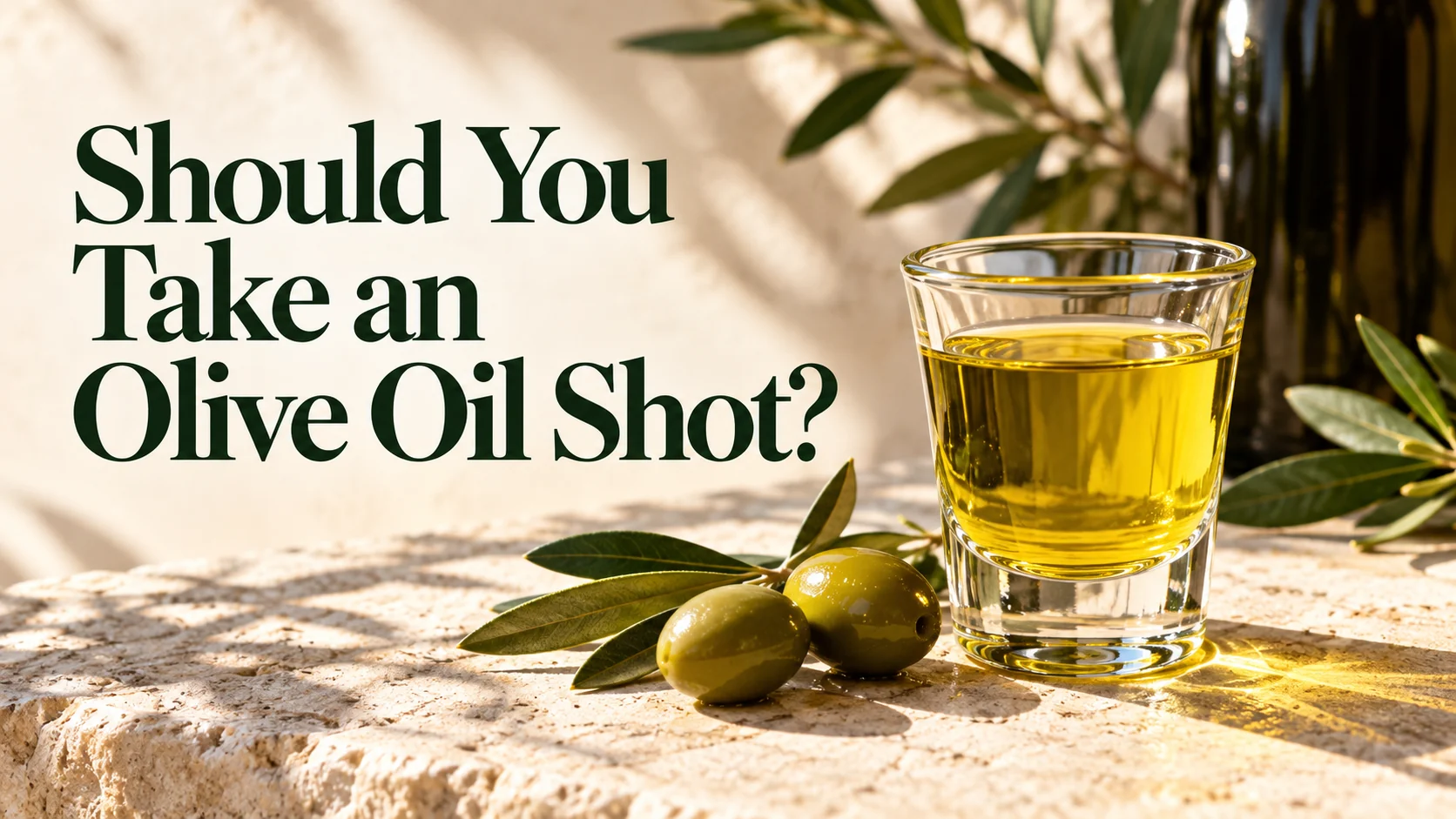
If you’ve seen someone swallow a shot of olive oil before breakfast, you may be wondering whether you should try it. My answer starts with a distinction: extra virgin olive oil can be a useful part of your diet, but drinking it from a shot glass has not been shown to offer special benefits over eating it with food.
You don’t need to push through nausea, chase the strongest throat burn, or set an early alarm to get olive oil into your day. I’ll help you separate the evidence from the ritual, understand the amount you’re actually pouring, and choose an oil you’ll enjoy using.
What is an olive oil shot?
An olive oil shot is simply olive oil consumed on its own, usually by the spoonful or in a small glass. There is no standardized shot size or medically established shot regimen. One person may mean a teaspoon; another may pour several tablespoons.
That difference matters. A tablespoon of olive oil supplies about 119 calories, according to USDA food-composition data. A generous free pour can become several servings before you notice.
When I evaluate this habit, I look at three things: the oil, the amount, and what it replaces in your diet. The shape of the glass tells me very little.
Are olive oil shots good for you?
The strongest reason to use olive oil is the evidence behind olive oil and healthy dietary patterns. It is not evidence that a separate morning shot detoxes your body, burns belly fat, or works better on an empty stomach.
Here are two studies that help put the claims into perspective:
- A whole dietary pattern: the corrected 2018 PREDIMED report found fewer major cardiovascular events in people at high cardiovascular risk assigned a Mediterranean diet supplemented with extra virgin olive oil or nuts than in the control group. Participants received dietary guidance. The trial did not isolate an olive oil shot.
- The oil’s phenolic content: the EUROLIVE trial compared oils with different phenolic concentrations in 200 healthy men. Participants consumed 25 mL daily for three-week periods, replacing other raw fats. Higher-phenolic oil produced more favorable changes in some lipid and oxidation markers. Those were short-term laboratory outcomes, not proof that a shot prevents heart attacks.
My practical reading is that olive oil deserves a place at the table. These studies don’t establish a special benefit from drinking it quickly, fasting beforehand, or adding it on top of everything you already eat.
For the broader evidence, I explain the benefits of extra virgin olive oil separately.
How much olive oil should you take?
There is no single research-backed shot dose for everyone. Studies use different oils, amounts, populations, and dietary instructions. Copying a dose without that context can be misleading.
If you want to try the flavor, a measured teaspoon with a meal is a small culinary starting point. That is a way to see whether you enjoy and tolerate it, not a treatment dose. You can also skip the spoon entirely and use that amount in a dressing or over vegetables.
Before adding more, count the olive oil you already use for cooking and finishing meals. If you already dress your lunch and cook dinner with it, a separate shot may simply add more oil.
I’d focus on a useful substitution, such as olive oil in place of some butter, and a portion that fits your overall food intake. A healthy fat still contributes energy. More is not automatically better, particularly if your goal is weight management.
A quick portion check
- 1 teaspoon: one-third of a tablespoon, approximately 40 calories.
- 1 tablespoon: approximately 119 calories.
- 2 tablespoons: approximately 239 calories.
These are approximate calculations from USDA’s tablespoon value. Use a measuring spoon at first. A kitchen spoon or a shot glass is not a reliable measure.

How many polyphenols are in a tablespoon?
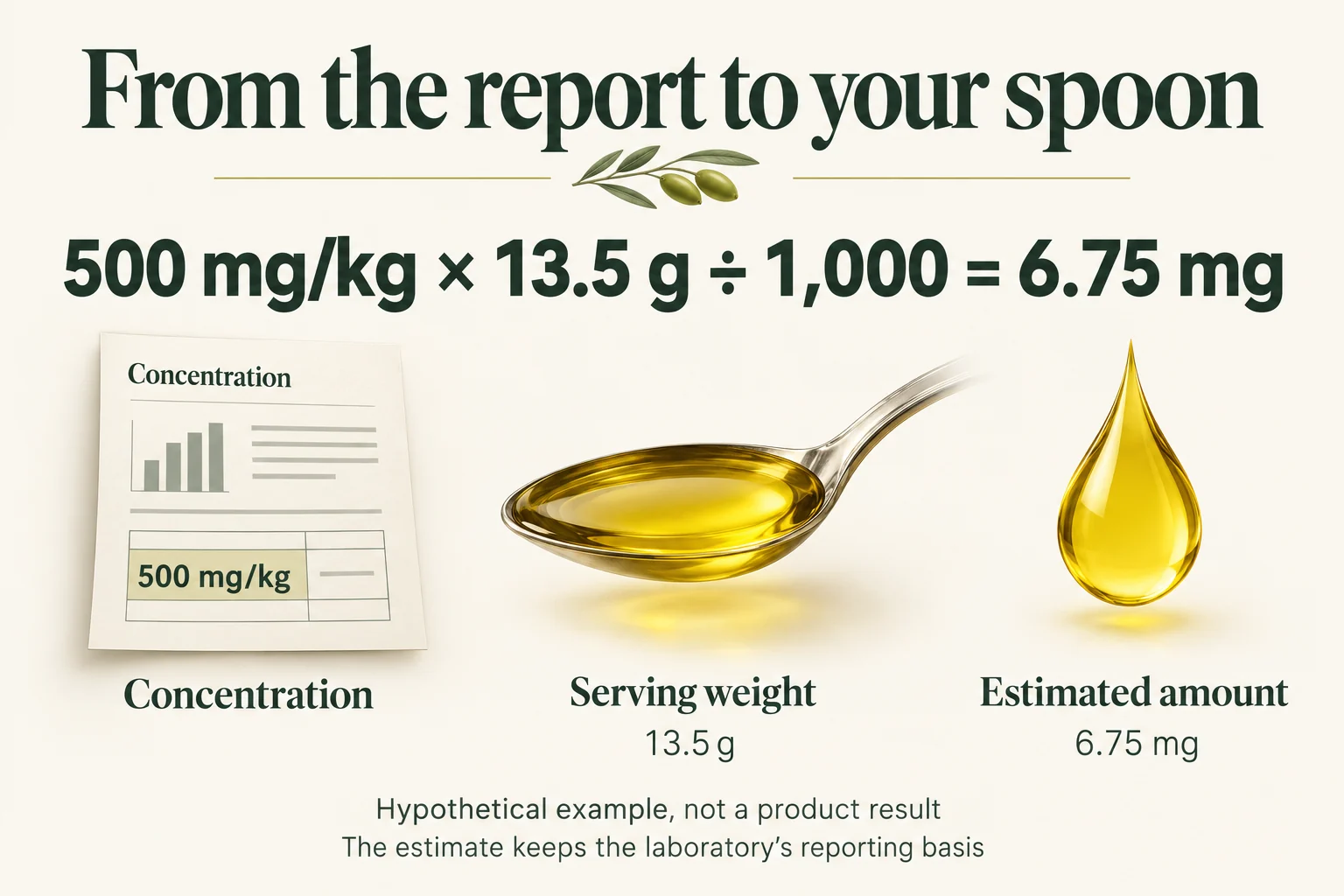
Polyphenols are a family of plant compounds found in extra virgin olive oil. A lab report may give their concentration in milligrams per kilogram, written mg/kg. That number describes the oil tested, not the amount in your spoon.
For an illustrative tablespoon weighing 13.5 grams, multiply the reported mg/kg by 0.0135:
- 100 mg/kg: approximately 1.35 mg per tablespoon.
- 250 mg/kg: approximately 3.38 mg per tablespoon.
- 500 mg/kg: approximately 6.75 mg per tablespoon.
- 1,000 mg/kg: approximately 13.5 mg per tablespoon.
These are arithmetic examples, not measured values for particular products or recommended daily targets. They assume the oil still matches its report and that the laboratory result is expressed on the same basis. Different testing methods may count different compounds.
There’s another distinction I want you to know. The EU olive oil polyphenol claim concerns protection of blood lipids from oxidative stress. Its conditions specify at least 5 mg of hydroxytyrosol and related compounds in 20 grams of oil, with information about consuming 20 grams daily. A generic “total polyphenols” number does not automatically establish that a bottle qualifies.
So I would not use a large label number to promise that one tiny spoon delivers the same health outcome as a dietary trial. The calculation tells you an estimated quantity; it does not prove a clinical effect.
Morning or night: does the timing matter?
The studies above do not establish that taking olive oil in the morning is better than taking it at night. They also do not establish that an empty stomach improves the outcome.
I’d choose a time that makes the habit comfortable and easy to remember. Lunch works. Dinner works. Using olive oil as part of a meal is a reasonable choice if drinking it straight feels unpleasant.
Be careful with claims that taking oil before a meal will “flatten” every blood-sugar spike. Small meal experiments and changes in digestion do not establish a reliable long-term glucose treatment. If you manage diabetes, keep your usual monitoring and treatment plan; don’t change medication around an olive oil trend.
Consistency can be useful, but it should serve your meals and your health goals. It should not become another rule you feel you have to get perfectly right.
Should you add lemon?
Add lemon if you like the taste. A squeeze can make a vinaigrette brighter or make a spoonful of oil more appealing. You can get that same flavor combination on a salad.
I would not describe lemon and olive oil as a liver cleanse, a gallbladder flush, or a proven weight-loss drink. None of the olive oil trials discussed here tested those promises. Adding lemon does not cancel the oil’s calories or turn it into a different treatment.
If lemon or concentrated oil makes you feel nauseated or worsens reflux, leave it out. There is no benefit to forcing yourself through a wellness routine that makes you feel worse.
Which olive oil should you use for a shot?
Start with extra virgin olive oil you enjoy. Then look for information you can check:
- A harvest date and identifiable batch. A best-by date alone does not tell you when the olives were harvested.
- Protective packaging. Keep the bottle capped and away from light and heat.
- A current lab report if polyphenols are the selling point. Look for the lot, laboratory, test date, method, and compounds measured.
- A taste you can use comfortably. Pepperiness can be a clue about composition, but it cannot certify a milligram amount.
Oleocanthal helps produce olive oil’s characteristic throat sting. Sensory research links that sensation to a receptor called TRPA1. It does not turn your cough into a laboratory test. A stronger sting is not a reason to take more.
My guide to high-polyphenol olive oils is the place to compare buying options. Before paying a premium, ask whether the current bottle is supported by current evidence, rather than an impressive result from an older harvest.
Full disclosure: I carry Laconiko and ZOI in my practice’s shop. You can view Laconiko extra virgin olive oil and Laconiko ZOI there. Check current availability and request the report for the lot being sold before choosing either for a specific polyphenol concentration.
Who should be cautious with olive oil shots?
A culinary amount of olive oil is different from a large bolus or a concentrated olive supplement. Most people do not need a special protocol to use it in food. The separate shot is optional.
If it causes nausea, diarrhea, or reflux, stop the shot and try a smaller amount with food if comfortable. Persistent symptoms deserve attention rather than an explanation that you are “detoxing.” If you have been given a fat restriction or have a condition that makes fatty meals painful, follow your clinician’s advice.
Do not substitute olive oil for prescribed treatment. And do not assume that research on a phenolic extract means an oil and a supplement have the same dose, safety profile, or effect. If you are considering concentrated extracts alongside medication, discuss the exact product with your clinician or pharmacist.
A simple way to make this useful
Here is the approach I’d use to make the decision manageable:
- Look at where fat already appears in your meals.
- Choose one place to use olive oil, such as a dressing, cooked vegetables, or toast.
- Measure your portion once or twice so you recognize it.
- Pay attention to taste and digestive comfort.
- Keep the bottle somewhere cool and dark, then use it regularly rather than saving it indefinitely.
If you enjoy taking that portion from a spoon, that’s an option. If you would rather eat it with lunch, you have not missed the point. I want this to help you build a satisfying meal, not distract you from one.
Frequently asked questions
Is an olive oil shot better than putting oil on food?
Research has not established that a shot is better. The important studies examine olive oil intake, phenolic content, or a broader dietary pattern. Eating it with food is a practical way to use it, and may be more comfortable than drinking it straight. Choose the format you enjoy without adding unnecessary extra portions.
Can olive oil shots help you lose weight?
A shot is not a proven weight-loss treatment. Olive oil can fit into a balanced eating pattern, but each tablespoon adds about 119 calories. I would look at what the oil replaces and your overall intake before adding a daily shot. It should complement a meal plan rather than become an automatic extra.
Do you need to take olive oil on an empty stomach?
No established evidence requires an empty stomach to obtain olive oil’s dietary benefits. If taking it before breakfast feels unpleasant, use it with a meal instead. There is no need to interpret discomfort as a sign that it is working, and no reason to force the ritual to match something you saw online.
How quickly will you notice a difference?
You may notice flavor and digestive tolerance immediately, but that is different from a measurable health change. Short-term studies often assess laboratory markers, while dietary outcomes may take much longer to study. A few days of clearer skin, more energy, or fewer cravings cannot establish that an olive oil shot caused the change.
About the Author
Based in San Diego, Dr. Erez, D.O. is a 5-star rated integrative medicine practitioner with over 5 years of experience running his own private practice and treating hundreds of patients. He is an Institute for Functional Medicine Certified Practitioner (IFMCP) and is board-certified by the American Board of Family Medicine.
A frequent medical source, he has contributed to publications including Everyday Health, Epoch Health, California Mobility, and Woman's World. Dr. Erez is most passionate about helping individuals identify the root causes of chronic disease and leverage evidence-based interventions to reach their version of optimal health.