How We Use CGMs to Help Patients Take Control of Their Blood Sugar
A continuous glucose monitor turns your blood sugar from a once-a-year number into a live picture of your day. Here's the exact way I use it with patients, and how you can get the most out of one yourself.

Why Blood Sugar Matters Even If You're Not Diabetic
Most people think blood sugar doesn't matter as long as you're not diabetic. But the truth is, you don't have to be anywhere near the diabetic range to feel the effects of your blood sugar swinging around all day.
If you feel your metabolism is 'broken', you have headaches, low energy, mood swings, sleep problems, or even skin issues, it might be due to this blood sugar dysregulation you're unaware of.
Now, it's completely normal for your blood sugar to rise after you eat. That's how it's supposed to work. The problem is that most of us, myself included, may have a few foods we might regularly consume that drive it up too high. And a big spike tends to be followed by a big crash. The tricky part is you can't reliably guess which foods are doing it.
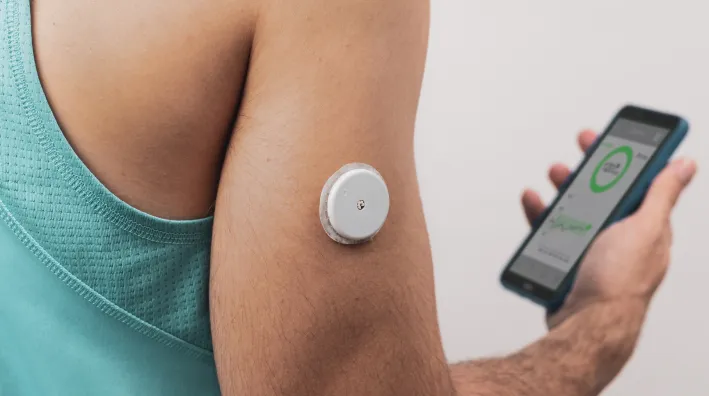
The best way to get clarity is a continuous glucose monitor, or CGM: a small sensor you wear on the back of your arm that reads your glucose around the clock and sends it straight to an app on your phone.
The real-time feedback is what sets it apart from the usual blood sugar tests. A fasting glucose is a single snapshot from one moment. An A1c is a three-month average. Both have their place, but neither one shows you how a specific meal, a walk after dinner, or a stressful afternoon actually moves your blood sugar in real time. A CGM does, and that's what makes it so actionable.
So in this post, I'll walk you through everything you need in order to get real value out of this health wearable:
- If a CGM is actually right for you
- Why I think it's one of the most useful tools we have
- The exact protocol I run with patients
- How to get started on your own
- Pro tips and answers to the questions that come up most
First things first: let's figure out whether a CGM is even right for you.
Understanding if a CGM is Right For You
I don't recommend a CGM for every patient. But if you recognize yourself in any of the signs below, it's worth talking to your doctor about whether one makes sense for you:
You have these lab markers:
- An A1c above 5.6%
- Triglycerides above 100, and certainly anything above 150
- A low HDL, generally under 40 for men or women
- A high triglyceride-to-HDL ratio
- Fatty liver, which often shows up as consistently elevated ALT or AST
You experience these symptoms:
- Post-meal fatigue, that crash where you get tired after lunch
- Headaches of any kind, migraine or otherwise
- Mood swings, anxiety, or sudden anger and rage that seems to come out of nowhere
- Constant hunger, or feeling like you can't get your appetite under control
You have these conditions:
- You're overweight and working on weight loss
- You have PCOS, which is often insulin-driven.
- You have skin tags, darkened patches of skin (acanthosis nigricans), or excess hair growth (hirsutism)
- You have a strong family history of diabetes
- You want to see how alcohol affects your glucose
You've made these changes:
- You just changed your diet and you want to see how your body actually responds
- You're on low-carb or keto and you should be losing weight but you're not
Please note: If you tend toward health anxiety, watching your numbers all day can feed that worry, so talk with your doctor first about whether it makes sense for you.
If you saw yourself somewhere in that list, let me tell you why I think it's so worth doing.
Why This Is One of the Most Actionable Tools We Have
Personally, I think everybody should do this at least once or twice.
Almost every patient has the same experience. They find out a food they eat all the time is trashing their blood sugar, and they had no idea.
It's usually something they'd never suspect such as a sweet hot sauce, a tomato sauce that turns out to be loaded with sugar, blueberries they assumed were nothing to worry about, etc.
For me, it was a matcha latte. I went out, ordered a matcha, and it spiked me like I'd been eating ice cream. I would not have believed it if I hadn't watched it happen.
And that is where the true value lies.
You get immediate, personal feedback that no lab can give you, and the change you make is small and completely doable. You realize you can't have a certain item, or you order it unsweetened, and you've suddenly stopped spiking your blood sugar several times a day.
Most people find the two or three things that make up ninety percent of their problem. I'd say that's a really good return for temporarily wearing a small sensor on your arm.
So once you've decided it's worth a shot, the real question becomes how to do it right.
Our CGM Protocol, Step by Step
Here's exactly how I walk patients through it, from picking your sensor to sitting down and reviewing your results together.
Step 1: Get your sensor and put it on
Start with the device. For most people I recommend the Dexcom Stelo:
- It's simpler and cheaper, and it's available over the counter, so you don't need a prescription.
- It runs about $80 to $90 a month, which is roughly two sensors since each one lasts 14 days. It's usually HSA eligible, and we can often get patients one free sample to start, as long as you're not on Medicare or Medicaid.
- I'll reach for the Dexcom G7 instead when someone has insurance that covers it or has clear diabetes, though it has more settings we'd want to walk through together.
Then put it on the back of your arm, over the triceps:
- Applying it is quick and close to painless. A spring-loaded applicator places a tiny, flexible filament just under the skin, much thinner than the needle you're probably picturing, and nothing stays in your arm.
- Most people barely feel it go on and forget it's there within a day. It's a small disc about the size of two stacked quarters, easy to tuck under a sleeve.
- Experiment with the exact spot, further back or around, so you don't catch it on a doorway. I don't recommend the belly or thigh.
Step 2: Decide how long you'll wear it
This depends on why you're wearing it:
- If you're working on insulin resistance or the classic metabolic syndrome picture (high triglycerides, low HDL, higher LDL, some extra weight), plan on three to six months so we have time to change habits and watch the numbers follow.
- If you're mostly curious or fine-tuning an already-solid diet, two to four weeks is usually enough to find your two or three biggest triggers. A lot of patients repeat that short stretch once every six months and get most of the value.
Step 3: Set your high alarm to 130
The default is 180, but that only tells you what you already know: you ate the cake, or the big bowl of rice. Drop it to 130 and you'll start catching the in-between spikes to 140, 150, or 160 after a meal you thought was balanced. Those are the repeat offenders that quietly drive dysregulation, appetite, and inflammation.
If the alarm ends up going off every time you eat, that points to more insulin resistance, and we'll nudge it up to 140 or 145 so it stays useful.
Here's what you're aiming for:
- Staying under about 140 after meals
- Coming back down within two to three hours
- A fasting number in the 70s to 90s
The shape of the line matters more than any single reading.
Step 4: Week one, eat normally and log every alert
Don't change a thing yet. This week is about capturing your true, everyday baseline. Any time the alarm goes off:
- Open the app
- Tap the plus or note button
- Write down what you just ate
Do it every single time. Those notes are what turn a screen full of squiggly lines into specific, fixable answers.
Step 5: Week two, start running experiments
Now go after the foods and situations you're actually curious about. Eat them the way you normally would, in a normal portion. Don't eat a whole can of beans by themselves to see what beans do.
Here are a few foods worth testing:
- Rice. This is the big one. Patients don't realize how much they eat, how easy it is to overeat, and how long it keeps their blood sugar elevated.
- Smoothies. A whole banana, half a container of blueberries, and sweetened oat milk hits your system fast because it's liquid, fruit and fiber and all.
- The restaurants you eat at regularly, so you know whether your usual order is spiking you.
Then test more than food:
- Walk for ten minutes after a spike and watch how fast it comes down.
- Keep an eye on your blood sugar during a workout.
- Notice what happens during a stressful drive or a heated conversation, sometimes with a little caffeine on board.
- After a short night of sleep, see how much more your numbers bounce around.
Blood sugar is tied to all of it, not just what's on your plate.
Step 6: Review together and adjust
This is where it pays off. When I work with patients, I pull up your data in Dexcom Clarity, look at a specific meal, see exactly what you ate, and we figure out how to modify it. Sometimes that's more fiber, sometimes a little vinegar with the meal, sometimes just changing the order you eat things so the spike gets blunted. Then you keep going with the tweaks that actually work.
Once you've got that rhythm down, a few small things will keep the whole experience smooth.
Pro Tips
We've made a list of a few things that come up with almost everyone. Knowing them ahead of time saves a lot of confusion.
- Don't panic over low readings at night. If you sleep on the sensor, the pressure can cut off circulation around it and drop the reading. People wake up convinced they had a hypoglycemic event overnight when they were simply lying on the device. You usually don't need to treat that, so don't go drink a gallon of orange juice or eat a Fruit Roll-Up. (If it's a nightly pattern and it lines up with real symptoms like waking up shaky, that's a different conversation, and the fix is a more complex meal with protein, fat, and a little complex carb, not fast sugar.)
- Take the first 24 hours with a grain of salt. A new sensor is more volatile for the first 12 to 24 hours. If the early readings look strange, wait a bit and see if the trend holds before you react.
- Expect a 10 to 15% variance from a finger stick. A CGM reads the fluid just under your skin, not your blood directly, and glucose takes a little longer to reach that fluid. So during a fast rise or fall, your monitor and a finger-stick meter will disagree a little. That's normal, and the devices keep getting better.
- Spot-check if something seems off. If your baseline suddenly reads higher than your last few sensors, say it starts at 115 or 120 when you're used to 100, the sensor itself may be the problem. You can grab a glucometer and strips at any pharmacy and do a quick finger stick to check. If a sensor is genuinely reading high, you can raise your alarm and ride it out, or call Dexcom, explain what happened, and they'll often send a replacement.
- Getting in water is mostly fine, the ocean is not. You can shower and swim in a pool with it on. A sauna can make the numbers read a little funny while you're in there, but it's generally okay. The ocean is the one place I'd keep it out of, since that's where you risk a problem.
Beyond those, here are the questions patients ask me most.
Frequently Asked Questions
Do I have to be diabetic to benefit from a CGM?
Not at all. Blood sugar dysregulation is a spectrum, and plenty of people with a normal A1c are still spiking throughout the day in ways that affect their energy, mood, sleep, and weight. A CGM is often most useful precisely for the person who isn't diabetic yet but wants to stay that way.
Does it hurt, and will people notice it?
Not really. A spring-loaded applicator places a thin, flexible filament just under your skin in about a second, and most people say they barely feel it. There's no needle left in your arm. The sensor is a small disc that tucks under a shirt sleeve, so most people wear it for two weeks without anyone noticing.
Do I have to be your patient to try one?
No. The Dexcom Stelo is over the counter, so you can buy one and start on your own. Working with me adds the interpretation: figuring out which spikes actually matter for you, what to change, and how your blood sugar ties into everything else we're tracking.
What's the most common misconception about CGMs?
That the number on the screen is your exact blood sugar. It's very close, but there's usually a 10 to 15% variance and a short lag, because the sensor is testing interstitial fluid rather than blood. During rapid swings you'll see a difference from a finger stick. Once you know that, the data is still incredibly useful.
I lift weights and I've heard blood sugar spikes don't matter if you're not diabetic. True?
Partly, for a specific group. If you carry a lot of muscle, you're probably very insulin sensitive, and when your blood sugar rises the sugar goes straight into muscle tissue where it belongs. The problem is that most people who are insulin insensitive don't have much muscle mass. Their sugar isn't going into muscle, it's heading to the liver and creating fatty liver. People with a lot of muscle can tolerate more carbohydrate in a healthy way, but that's a small, very fit slice of the population, not most of us.
Does insurance cover it?
Occasionally, but it's rare. To get a Dexcom covered you typically have to be diabetic and using insulin multiple times a day. Standard insurance usually won't cover it for the way we're using it, which is why the Stelo, at $80 to $90 a month and HSA eligible, is often the simplest route.
How often should I wear one?
For some people, two to four weeks once is enough to find their big triggers. If we're actively managing insulin resistance or working on weight loss, three to six months gives us more to work with. And any time you significantly change your diet, it's worth putting a new sensor on to see how your body responds.
Should I get one if I know I'm an anxious person?
Maybe not, or maybe just once. A CGM can feed health anxiety, especially around normal nighttime lows. If you know you'll fixate on every reading, this might not be the right tool for you, and that's fine.
*This article is for educational purposes only and does not constitute medical advice, diagnosis, or treatment. Always consult a qualified healthcare provider before making health decisions.
About the Author
Based in San Diego, Dr. Erez, D.O. is a 5-star rated integrative medicine practitioner with over 5 years of experience running his own private practice and treating hundreds of patients. He is an Institute for Functional Medicine Certified Practitioner (IFMCP) and is board-certified by the American Board of Family Medicine.
A frequent medical source, he has contributed to publications including Everyday Health, Epoch Health, California Mobility, and Woman's World. Dr. Erez is most passionate about helping individuals identify the root causes of chronic disease and leverage evidence-based interventions to reach their version of optimal health.